
Emergency Air Duct Cleaning Near Me: What Milpitas Homeowners Should Do First
If you’re searching “emergency air duct cleaning near me” in Milpitas right now, the single most important thing to know is this: in most situations, cleaning is not your first step. It’s step three. The immediate priority is shutting your HVAC system down, containing whatever got into it, and documenting the situation before anyone touches anything. If you’d rather not handle the triage yourself, call (877) 358-5491 and we’ll walk you through it over the phone.
Step One: Shut the System Down and Seal the Registers
This applies to every duct emergency in Milpitas, whether it’s smoke from the Diablo Range fires, water from a supply line break, rodent activity, or a sudden burst of debris from your vents. Running the blower is how contamination spreads. Every minute the fan spins, whatever is in the ductwork gets distributed into rooms that were previously clean.
Here’s the containment sequence we recommend, and it takes about five minutes:
- Set the thermostat to “off” (not “fan on” – make sure the fan setting is on “auto” or “off”)
- Locate your circuit breaker and switch off the air handler/Furnace breaker. This prevents accidental restarts.
- Close all supply registers and return grilles in every room
- Use painter’s tape or plastic sheeting over registers if the contamination is severe (soot, sewage water, or vermin droppings)
- Open a window in the affected room if weather permits, to let airborne particulates dissipate
In Milpitas homes, the furnace is typically in the garage, a hallway closet, or an attic space. If yours is in the garage, close the garage door while you’re dealing with the problem, because garage dust and exhaust fumes will find their way into the return plenum if it’s pulling air.
Wildfire Smoke: Why Cleaning Too Early Can Make It Permanent
We get a lot of calls from Milpitas homeowners after fire season. The air quality index climbs, the hills east of town go brown, and within a week someone notices the house still smells like a campfire every time the air kicks on.
Here’s what most people don’t realize: smoke odor that persists after the outdoor air clears is rarely just loose soot sitting in the ducts. It’s often baked onto the evaporator coil, the blower wheel, and the interior surfaces of the plenum. Cleaning the ducts while those components are still coated does nothing for the smell.
Worse, if you run a duct cleaning with standard agitation and negative air before the coil is addressed, you can pull fine particulate deep into the coil fins and set the odor in. We’ve seen systems in Milpitas where a rushed cleaning after the 2020 SCU Lightning Complex fires actually made the smoke smell harder to remove, because fine ash got driven into the coil instead of vacuumed off the surface.
The correct sequence after wildfire smoke exposure is: first, inspect the coil and blower. Second, clean those components (this typically requires pulling the coil access panel, which is a job for a pro because the refrigerant lines are right there). Third, clean the ductwork and replace the filter with a high-MERV option, like a Honeywell media filter. Only then does the smoke smell actually clear.
Post-Water-Damage Odor: Map the Moisture First, Clean Second
A water event in a Milpitas home – a supply line leak, a water heater failure, a slab leak – creates a very specific set of conditions. The ductwork may be involved, or it may be fine. The problem is, you can’t tell by smell alone.
If the water event was recent and you’re getting a musty odor from the registers, here’s the triage:
- Moisture mapping first. A restoration contractor or a duct specialist with a moisture meter checks the duct runs, the plenum, the insulation inside the ducts, and the areas around the registers. In Milpitas, ductwork usually runs through the slab, the crawlspace, or the attic, and each of those environments holds water differently.
- Mold clearance testing. If moisture is confirmed inside the duct system, you need a mold assessment before anyone starts brushing or blowing. This isn’t optional. Running a cleaning without knowing whether you’re dealing with active mold growth can aerosolize spores into the entire living space.
- Containment and removal. Only after mapping and clearance testing does cleaning or replacement make sense. In some cases, the right call is replacing a section of duct, not cleaning it. Wet insulation inside flex duct doesn’t dry properly; it needs to go.
We work with Abatement Technologies containment equipment for exactly this reason. If there’s a confirmed mold issue in your Milpitas ductwork, the remediation should happen under negative pressure with HEPA filtration, not with a rotating brush and a shop vac.
Vermin in the Ducts: What “Evidence” Means and Why You Shouldn’t Disturb It
Rats and mice in Milpitas are a year-round reality, especially in homes near open space, the creek corridors, or older neighborhoods with mature landscaping. And rodents love ductwork. It’s warm, it’s dark, and nothing bothers them.
If you hear scratching in the ceiling, or you find droppings around a register, or there’s a persistent urine smell in one specific room, you’re dealing with vermin intrusion. The first call here is not to a duct cleaner. It’s to a pest control operator who handles exclusion work.
Here’s why the order matters:
- A cleaning removes droppings and soiled insulation, but it doesn’t close the entry points the animals used to get in.
- If the animals are still present, a cleaning is wasted work. They’ll re-soil the ductwork within days.
- Disturbing nesting material can spread dried urine particles, fleas, and other contamination through the system if containment isn’t in place.
- For insurance purposes, you want photos of the intrusion points, the nesting sites, and the damage before the duct system is touched.
Once exclusion is complete and the entry points are sealed, then cleaning and repair come in. We’ve pulled nests out of duct runs in the Piedmont area of Milpitas that filled a contractor trash bag, but the real fix was a well-sealed crawlspace vent the homeowner never knew was compromised.
Sudden Debris Discharge: When It’s Not a Cleaning Problem At All
Sometimes we get a call from a Milpitas homeowner who says, “I turned the heat on and a bunch of black specks blew out of the registers.” Or worse, white fluff, or shreds of mylar, or what looks like sand.
That’s a red flag, and the answer is rarely “schedule a cleaning.”
Here’s what sudden debris discharge typically means:
- Black specks around registers: Usually a failing register boot gasket, degrading flex duct liner, or a blower motor starting to shed material. Could also be soot from a cracked heat exchanger, which is a carbon monoxide concern and an immediate HVAC service call.
- White fluff or fiberglass: The internal liner of flex duct has failed. This duct section needs replacement via air duct repair in Milpitas, not a brushing.
- Sand or grit from certain rooms only: Often a separated duct connection in the slab or crawlspace, pulling in soil from beneath the house. Again, a repair issue.
- Mylar shreds or plastic bits: The inner liner of a flex run has come apart. Cleaning won’t fix this.
A sudden debris discharge usually points to mechanical failure, not accumulated dust. Professional-grade inspection cameras (the kind used with Rotobrush and Nikro systems) can identify the source in about twenty minutes. In our experience, maybe one in five of these calls ends up being a cleaning job. The rest are repairs.
Insurance Documentation: The Step Too Many Milpitas Homeowners Skip
If your duct situation involves water damage, fire damage, mold, or vermin, there’s a decent chance your homeowner’s policy covers at least part of the remediation. But coverage depends heavily on documentation and on not making things worse before the insurance company has a chance to assess.
Before any cleaning or repair work begins, take these steps:
- Photograph everything. The registers, the visible contamination, the water stains, the rodent droppings, the affected rooms. Use your phone’s date stamp or hold a newspaper in frame to establish timing.
- Keep a written timeline. When did you first notice the odor or issue? When did the water event happen? What did the HVAC system do afterward?
- Retain any damaged components. If a duct section is removed, keep it. If a filter is loaded with soot or mold, bag it and keep it for the adjuster. Do not throw these things out.
- Contact your insurer before authorizing major work. For water and fire claims especially, the adjuster may want to inspect before demolition or cleaning happens.
A rushed “emergency cleaning” that disturbs the evidence can reduce a covered claim or get it denied outright, because the adjuster can no longer see the original condition. This is the single most expensive mistake we see in Milpitas, and it happens because a homeowner panicked and called the first company that answered the phone.
What a Real Emergency Response Looks Like From a Duct Specialist
If you call us with an active duct emergency, here’s what happens, assuming you’ve already shut the system down:
First, we triage over the phone. We’ll ask what happened, when it happened, and what you’re seeing or smelling. In a surprising number of cases, we can tell you right then whether this is a cleaning job, a repair job, or a call to someone else entirely. We’re an air duct cleaning company in Milpitas, but we’re honest about what cleaning can and can’t solve.
Second, same-day inspection and containment. If the situation is active, we come out the same day. The goal of that first visit is not to clean. It’s to inspect, identify the source, seal off affected areas if needed, and give you a clear scope of work with pricing you can actually make a decision from.
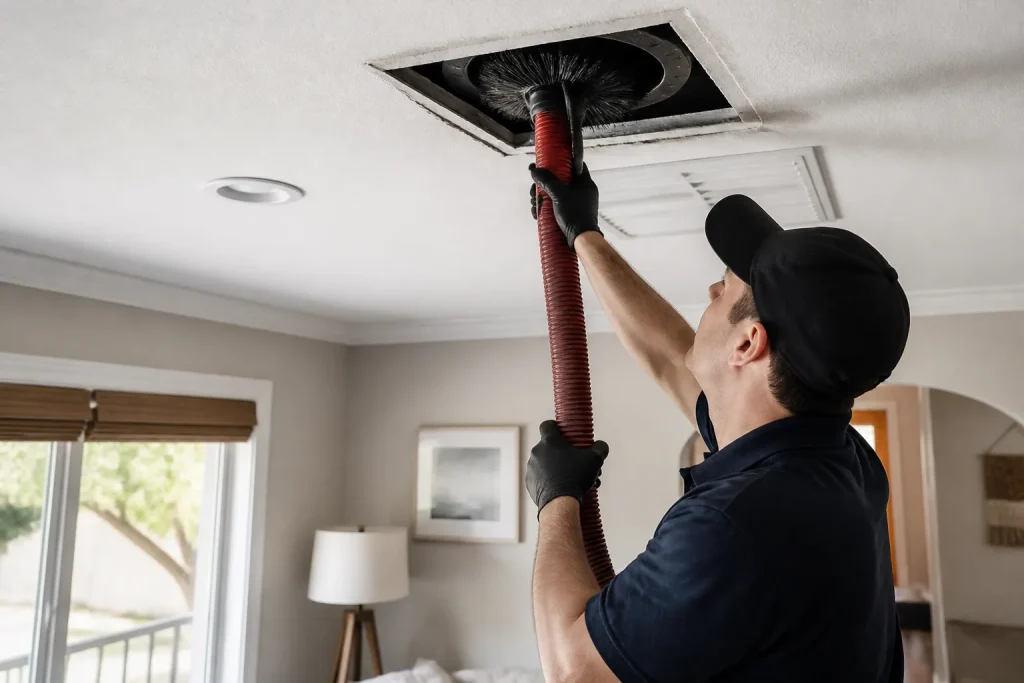
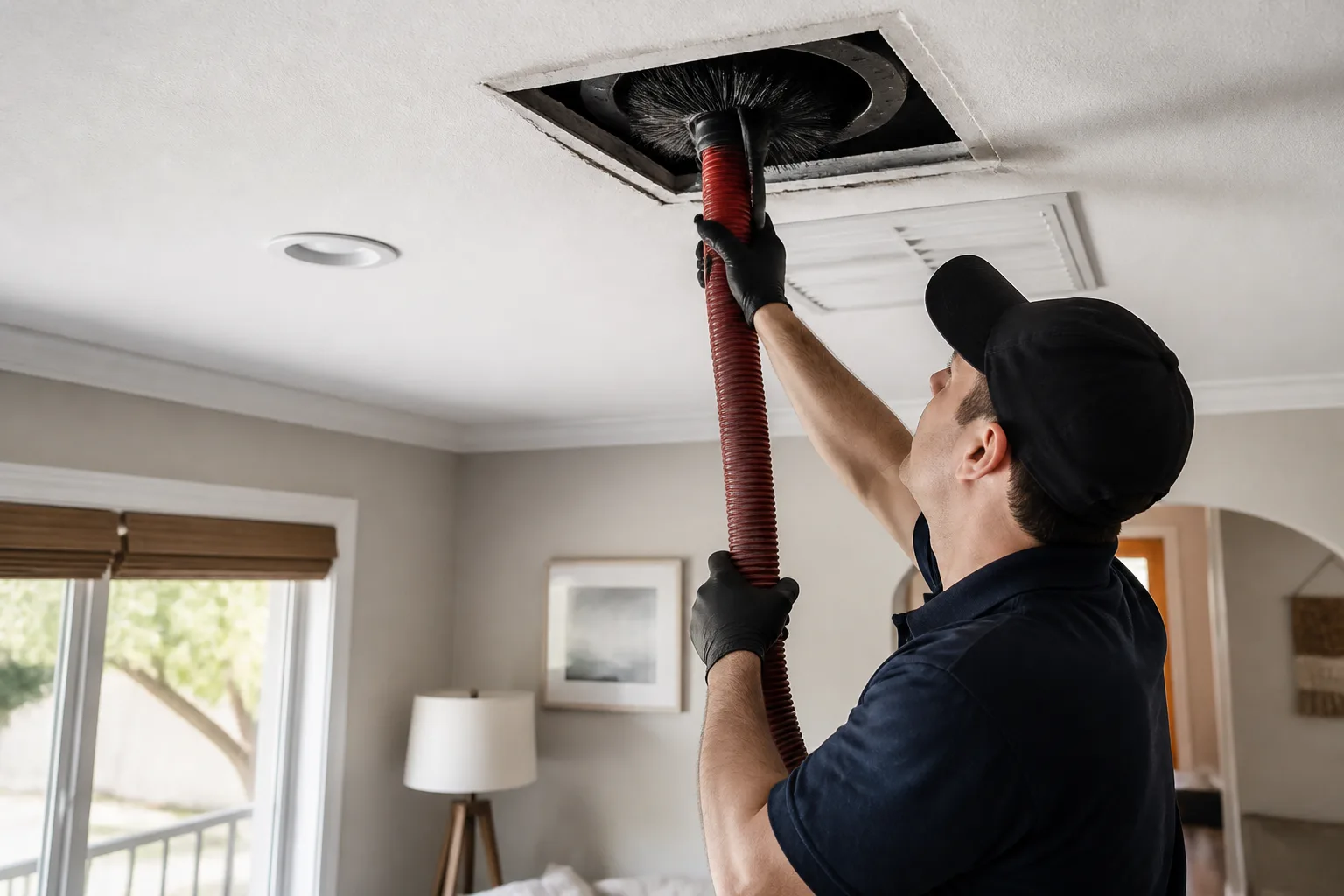
Third, the work itself. Cleaning happens when it’s the right time, with equipment suited to the job. That means Rotobrush or Nikro negative-air systems for standard duct cleaning, and Abatement Technologies HEPA containment units when we’re dealing with mold or hazardous particulates. Not a shop vac. Not an improvised setup.
The distinction matters. A company that shows up to “emergency clean” without inspecting first is not doing you a favor. Same-day inspection and containment is a real service. Rushed full cleaning is how contamination spreads.
When to Call a Pro
Here’s the simple version. Call a duct professional if:
- You shut the system down and still smell smoke, musty odor, or vermin urine
- You see visible mold on or around registers, or inside the plenum
- Debris continues to discharge from registers after you’ve turned the system off
- You have confirmed water damage that may have reached the ductwork
- You need documentation of the duct condition for an insurance claim
Related services in Milpitas: if the issue is lint buildup in your dryer duct, that’s a different system entirely and worth addressing separately through dryer vent cleaning. We handle both, plus structural repair, so the entire duct picture gets covered in one visit.
The Bottom Line
In Milpitas, “emergency air duct cleaning” is usually a three-step process: shut it down, contain it, assess it. Only then does cleaning make sense, and only if cleaning is actually what the system needs. Rushing into a cleaning when the real problem is a saturated coil, a torn duct liner, or a rodent entry point wastes money and can make the problem worse.
If you’re in Milpitas and dealing with any of the situations above, Duct Cleaning Milpitas offers free phone triage and free estimates. Call (877) 358-5491 and we’ll help you figure out what you’re actually dealing with before anyone picks up a brush. We carry Honeywell and Aprilaire filtration products, and we’ll recommend the right filter for your system after the cleaning, because the cleaning itself is only half the air quality equation.
Frequently Asked Questions
Same-day inspection and containment is available in most cases. Same-day full cleaning is sometimes possible if the inspection confirms that cleaning is the right call and the schedule allows, but we won’t rush a cleaning ahead of proper assessment. The inspection determines the plan. Call (877) 358-5491 to talk through a specific situation.
The quickest indicators are visual: you see dust, debris, or staining on the inside of the registers; you see debris actively blowing from the registers when the system runs; or you smell a persistent odor that’s clearly coming from the vents, not from the room itself. If the odor is coming from the vents only when the system runs, it’s a duct-related issue. If the smell is constant regardless of HVAC operation, the problem may be elsewhere in the home.
In most cases, smoke contamination can be cleaned rather than replaced, provided the coil, blower, and ducts are all addressed in the right order. The exception is when smoke exposure was extreme enough to leave an oily residue on porous duct liner, which sometimes occurs in homes close to active fire zones. In those situations, replacing the affected flex duct is the cleaner long-term fix.
Replace it, and don’t run the system until you do. A filter that has captured smoke particulate, mold spores, or vermin contamination will release some of that material back into circulation when airflow starts up again. Use a MERV 11 or higher filter for the replacement if your system can handle the added airflow resistance, and change it again after the cleaning is complete. Call (877) 358-5491 if you’re not sure which filter your system uses.
Written by the team at Duct Cleaning Milpitas, serving Milpitas since 2018.
Need Air Duct Cleaning Help?
Call Duct Cleaning Milpitas - licensed & insured, with free written estimates in Milpitas.
(877) 358-5491