
Last updated November 2, 2026
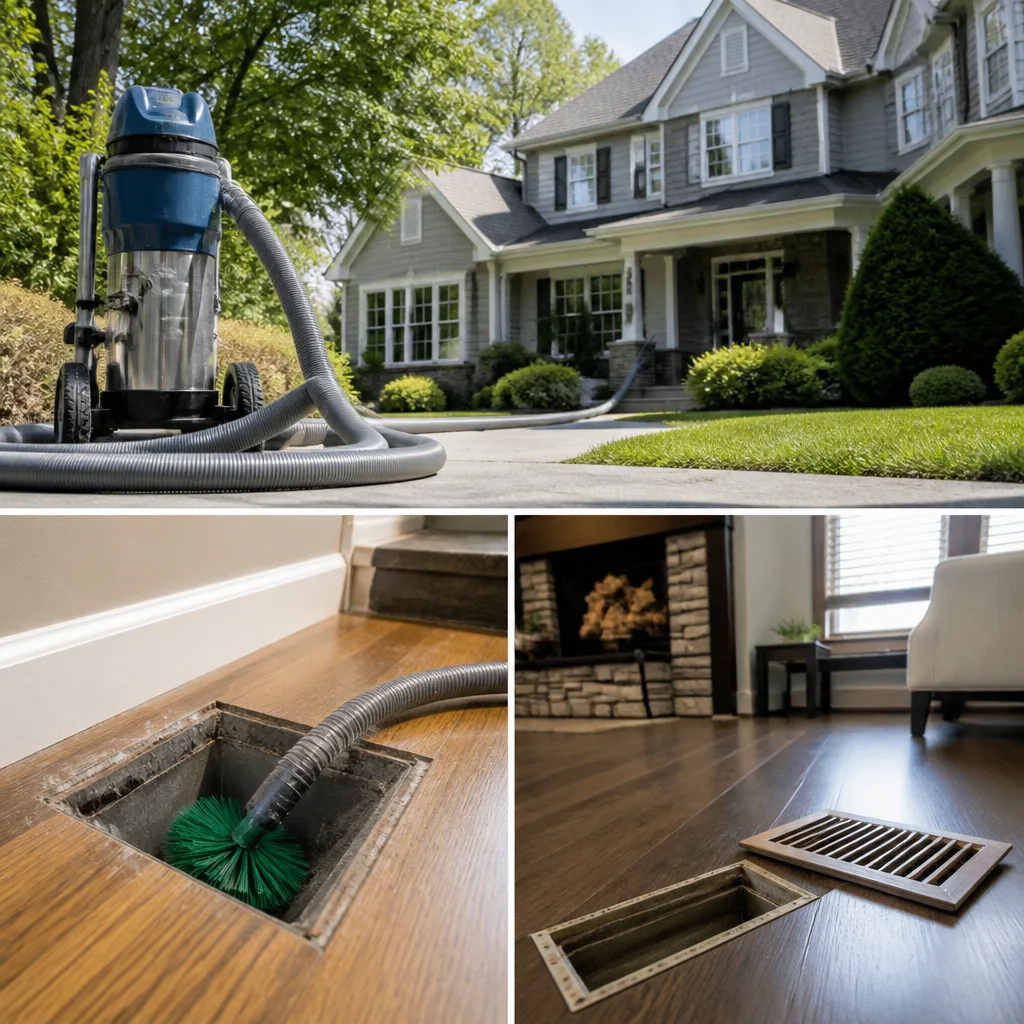 Whole-home duct cleaning
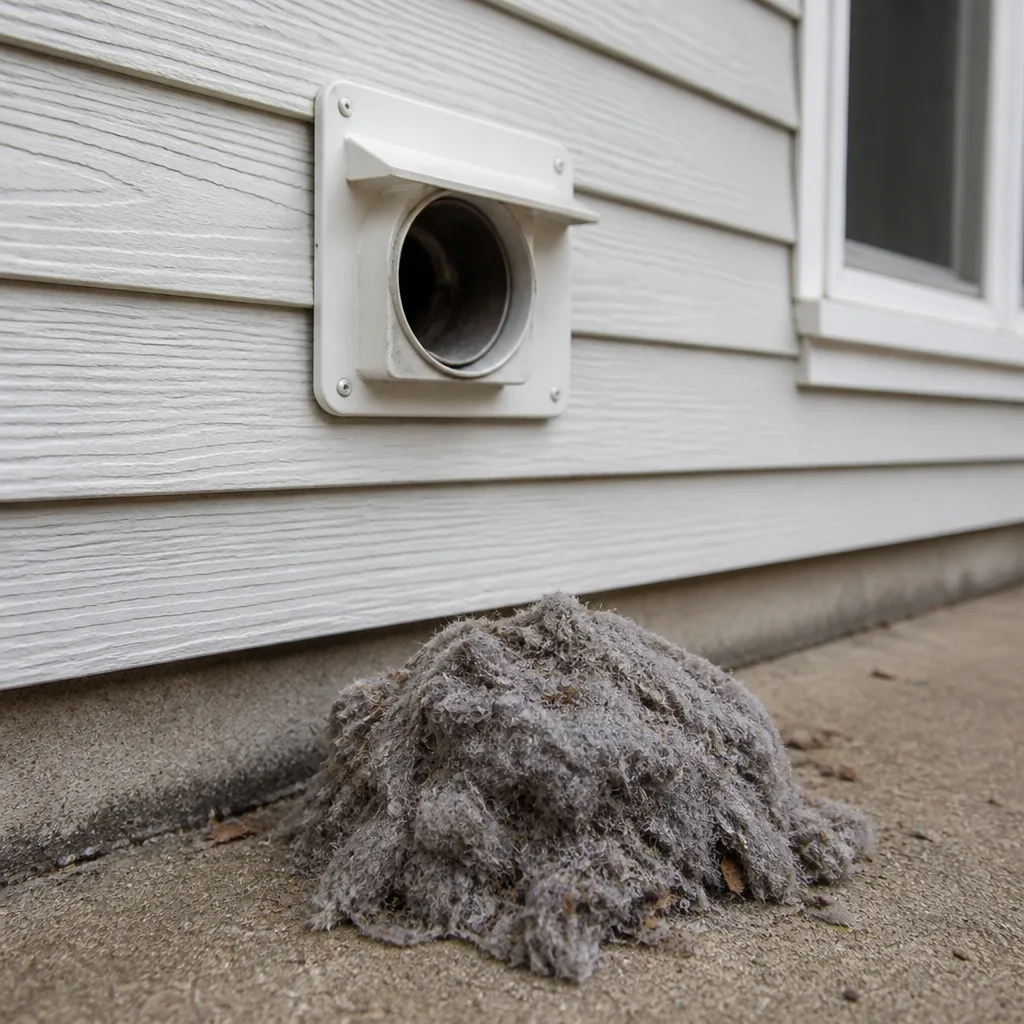 Dryer vent cleaning
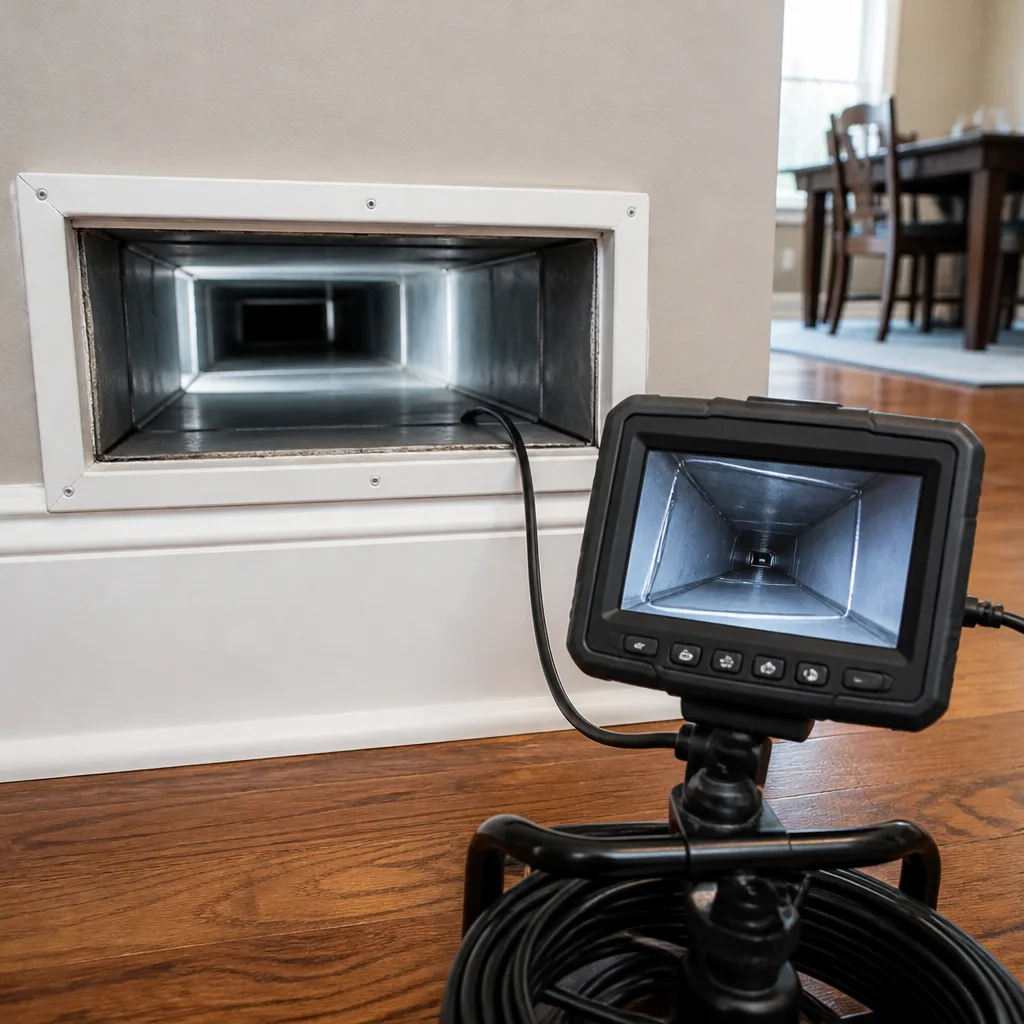 Camera inspection
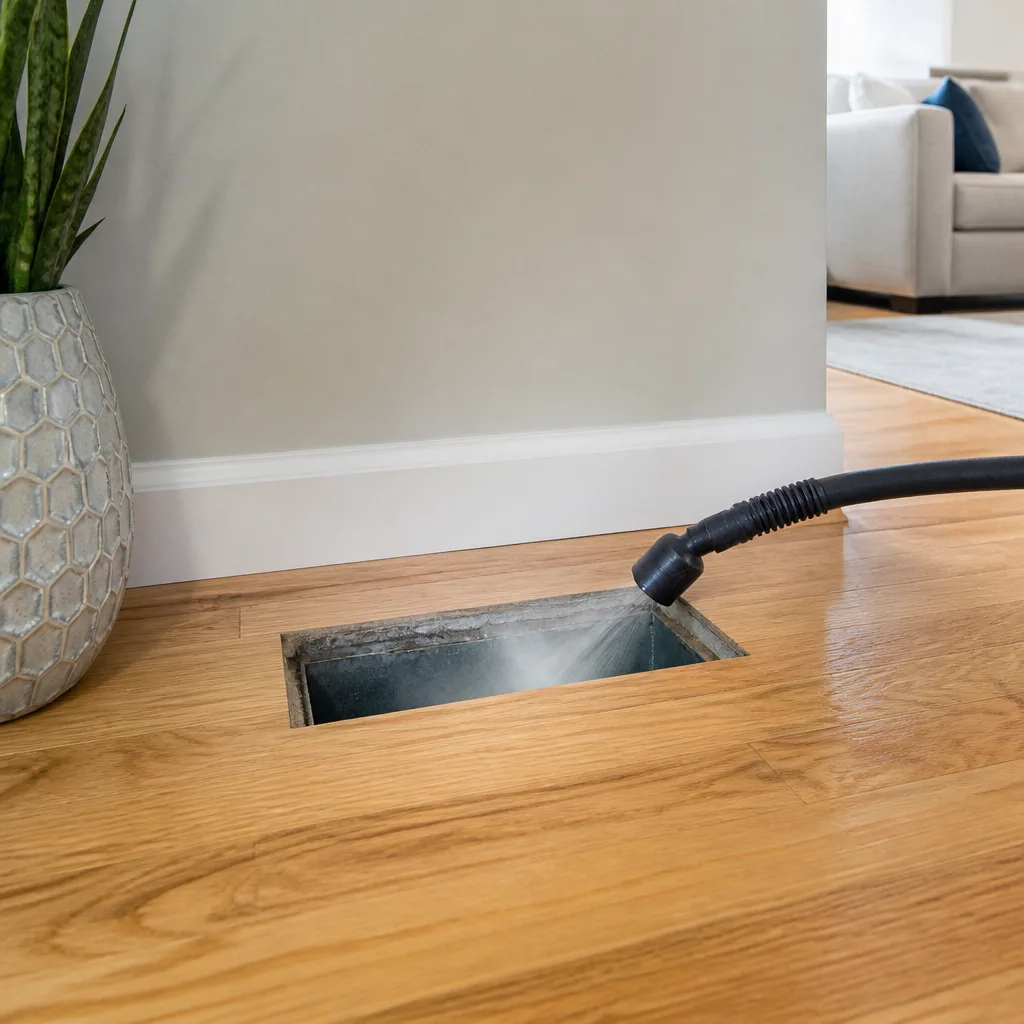 Sanitizing & deodorizing
Whole-system duct and dryer vent check with before-and-after photos - you see exactly what came out of your vents
That "$99 whole-house special" is a bait ad - the real number appears once they are in your hallway, or the "clean" is a shop-vac at the register. We photograph the inside of your ducts before and after instead.
DIY vs Professional Air Duct Cleaning: The Milpitas Homeowner’s Decision Guide
The most popular DIY duct cleaning tool on Amazon is a flexible brush kit originally designed for dryer vents. Homeowners in Milpitas buy it, attach it to a drill, and run it through their HVAC supply ducts. The result is often the exact opposite of what they intended: debris dislodged from duct walls gets pushed toward the air handler, where it settles on the evaporator coil and blower assembly. This guide and our How to Hire an Air Duct Cleaning Contractor in Milpitas: A Step-by-Step Guide explain the real boundary between what a homeowner can safely handle and what requires professional equipment, because that boundary matters more in Milpitas than in most places. Our valley climate means HVAC systems run a specific cycle here, and the dust load in Milpitas homes has its own character. By the end, you’ll know exactly which tasks to do yourself, which to leave alone, and how to spot the difference between surface cleaning and actual source removal.
Quick Answer
DIY air duct cleaning in Milpitas is appropriate for three tasks: register vacuuming, filter replacement, and dryer lint trap cleaning. True interior duct cleaning requires negative-pressure equipment that no consumer tool replicates. If you’re cleaning registers and changing the filter, you’re doing legitimate maintenance. If you’re pushing a brush into supply ducts, you’re likely creating a problem that will cost more to fix than a professional cleaning would have cost in the first place.
Styles & brands we work with
- Whole-home duct cleaning
- Dryer vent cleaning
- Camera inspection
- Sanitizing & deodorizing
Table of Contents
- What DIY Can Actually Accomplish
- The Physics of Source Removal: Why Consumer Equipment Falls Short
- The Real Cost Comparison: DIY Savings vs. Risk-Adjusted Expense
- When DIY Creates Professional Remediation Jobs
- Milpitas-Specific Factors That Change the Equation
- Maintenance Intervals: Using DIY Correctly as a Complement
- Equipment Matters: What Professional-Grade Actually Means
What DIY Can Actually Accomplish
There’s a persistent myth that homeowners can’t do anything about their duct systems. That’s not true. There are three tasks that are genuinely useful, safe, and within reach of anyone with basic tools. The key is understanding that these tasks are maintenance, not cleaning.
1. Register and Grille Vacuuming
Remove the supply and return registers in each room. Use a crevice tool on a household vacuum to remove visible dust, pet hair, and debris from the first few inches of accessible duct. This is surface cleaning. It improves airflow at the register face and removes what you can see. It does not clean the duct interior, and no one should pretend it does.
In Milpitas homes, registers in high-traffic areas like the living room and main hallway tend to accumulate a specific mix: fine clay dust tracked in from yards, pet dander, and the gray particulate that settles out of forced-air systems. Vacuuming these monthly is worthwhile.
2. Filter Replacement
This is the single highest-impact DIY task. A clean filter protects the blower motor and evaporator coil from dust loading. In Milpitas, where summer cooling season runs long, a clogged filter forces the blower to work harder, reduces airflow across the coil, and can lead to coil freeze-up. Replace standard 1-inch filters every 30 to 60 days during peak cooling. Homes with pets or residents with allergies should lean toward the 30-day end. Consider upgrading to a higher-MERV filter from Honeywell or Aprilaire if your system can handle the additional static pressure. Not all systems can. A filter that’s too restrictive creates its own set of problems.
3. Dryer Vent Lint Trap Cleaning
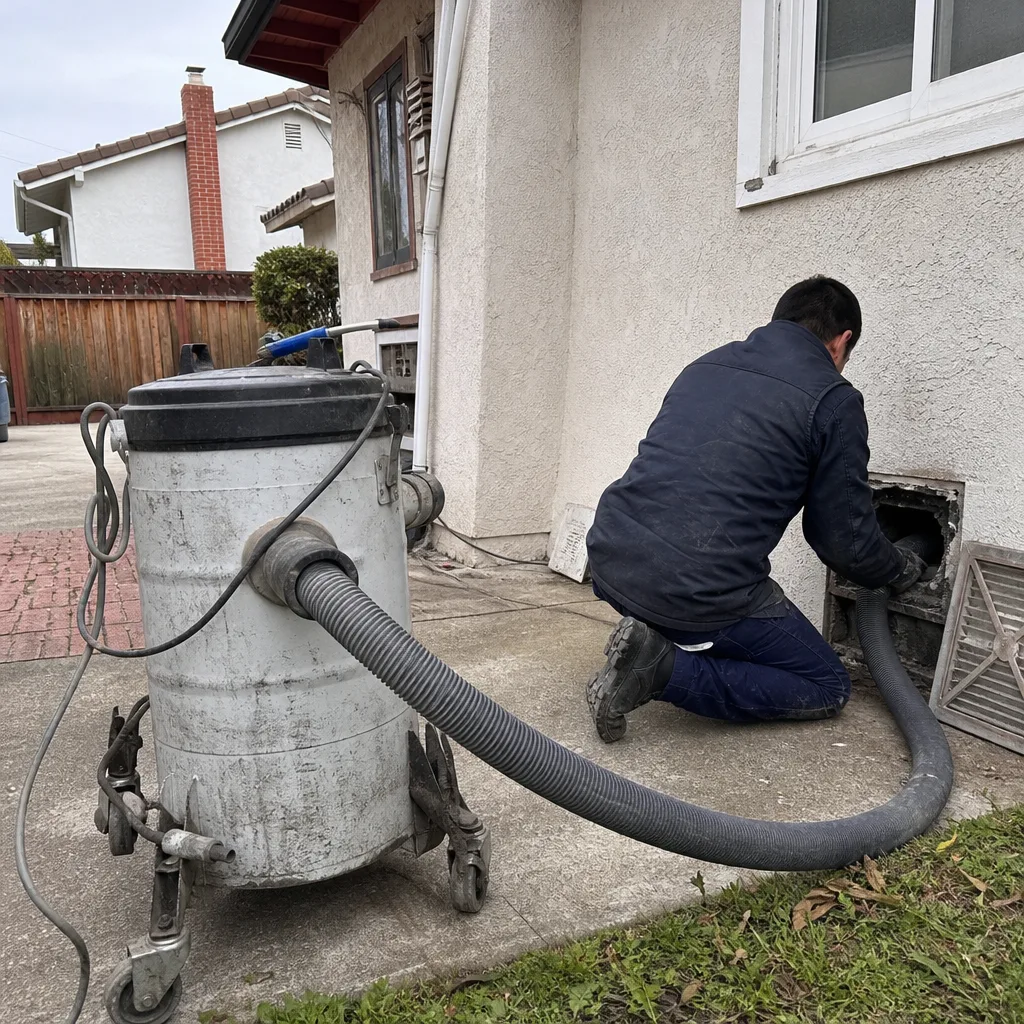
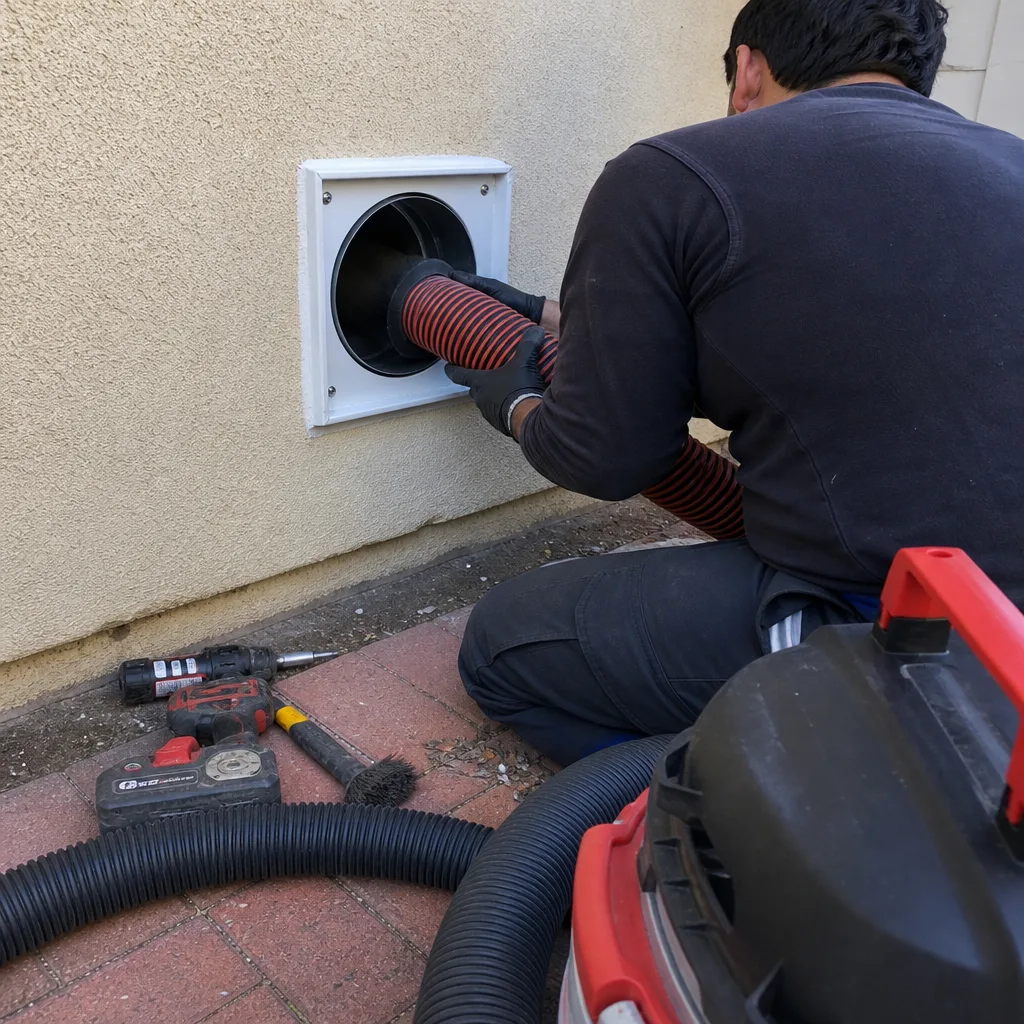
Clean the lint screen after every load. That’s routine. The DIY task here is checking the exterior vent hood: make sure the flap opens freely when the dryer runs and isn’t blocked by lint or debris. Milpitas homes with second-floor laundry rooms often have long vertical vent runs that trap lint quickly. If you can reach the exterior termination, clear visible lint from the hood. If the vent run is long, inaccessible, or hasn’t been cleaned in more than two years, that’s a job for professional dryer vent cleaning in Milpitas. Lint accumulation is a fire hazard, and the risk compounds with run length and bends.
What DIY Cannot Do
- Remove dust bonded to duct walls by static charge and moisture cycles
- Access the full length of trunk lines and branch runs
- Capture dislodged debris under negative pressure so it leaves the home
- Clean the blower motor, evaporator coil, or air handler interior
- Remove biological growth, if present
- Repair damaged flex duct, disconnected joints, or crushed trunk lines
The honest framing: DIY tasks maintain the system. Professional cleaning removes accumulated contamination from the interior. Both have a place. Confusing them is where Milpitas homeowners get into trouble.
The Physics of Source Removal: Why Consumer Equipment Falls Short
Professional air duct cleaning follows a standard called source removal. The reference organization is NADCA, the National Air Duct Cleaners Association. Source removal means physically dislodging debris from duct surfaces and extracting it from the system under negative pressure. The key word is extraction.
Here’s the physics problem with every consumer approach, whether it’s a brush kit, a shop vac, or a leaf blower adapted for ducts. Without negative pressure applied to the entire duct system, any debris you dislodge has only one place to go: deeper into the system, toward the air handler, or through gaps into wall cavities.
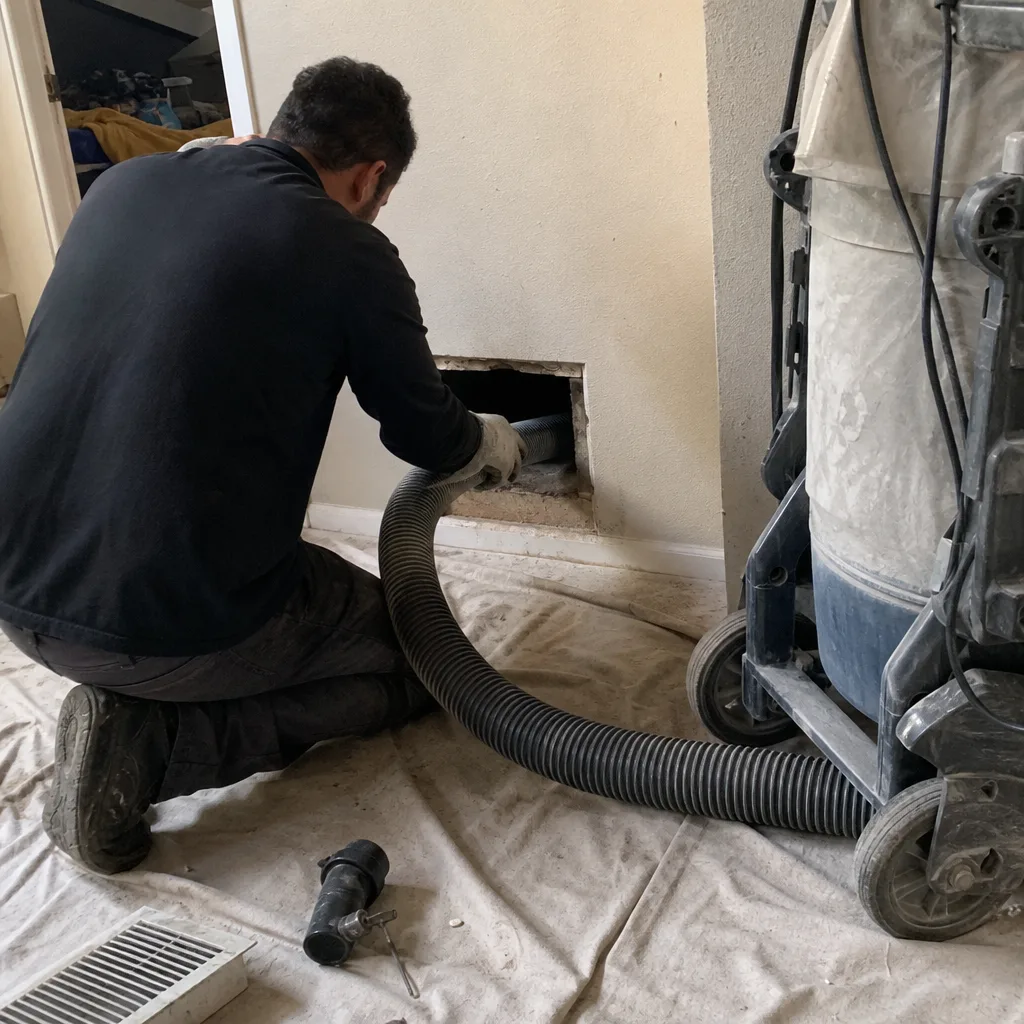
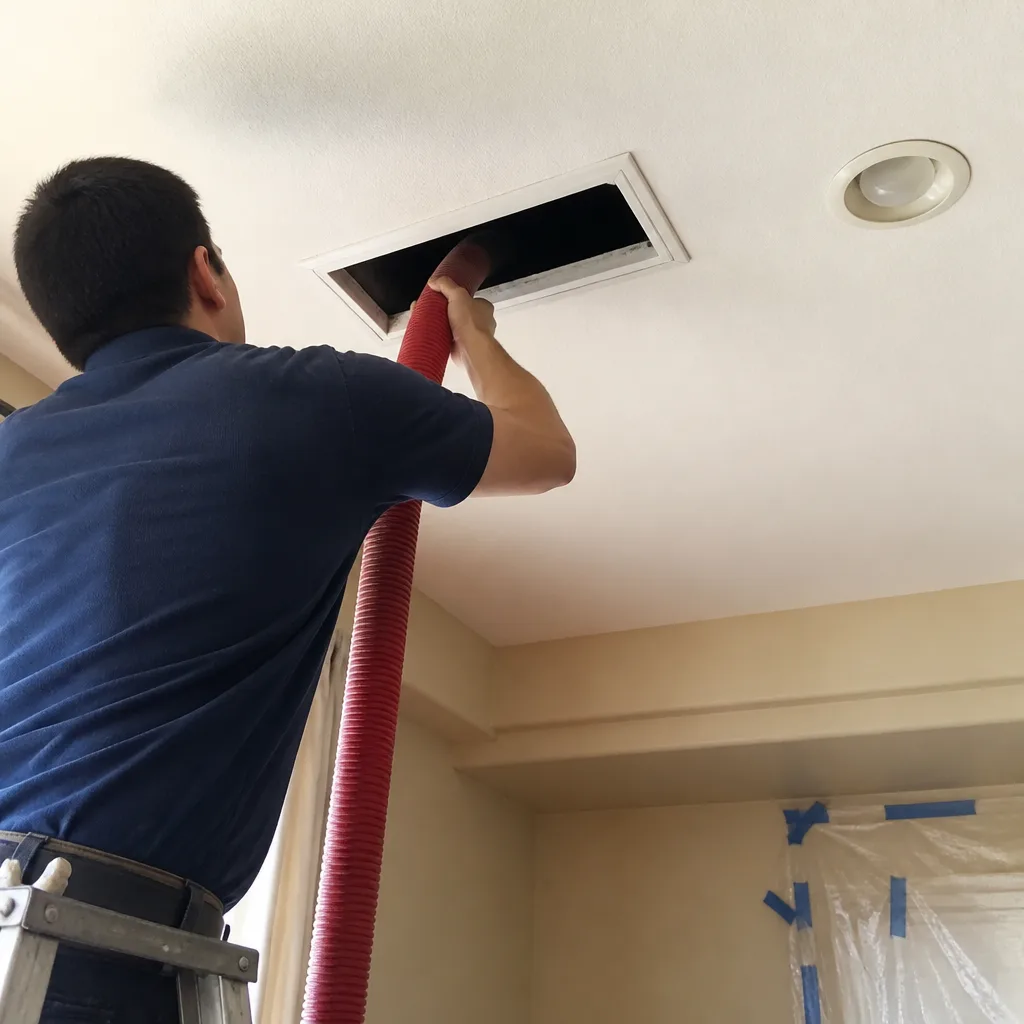
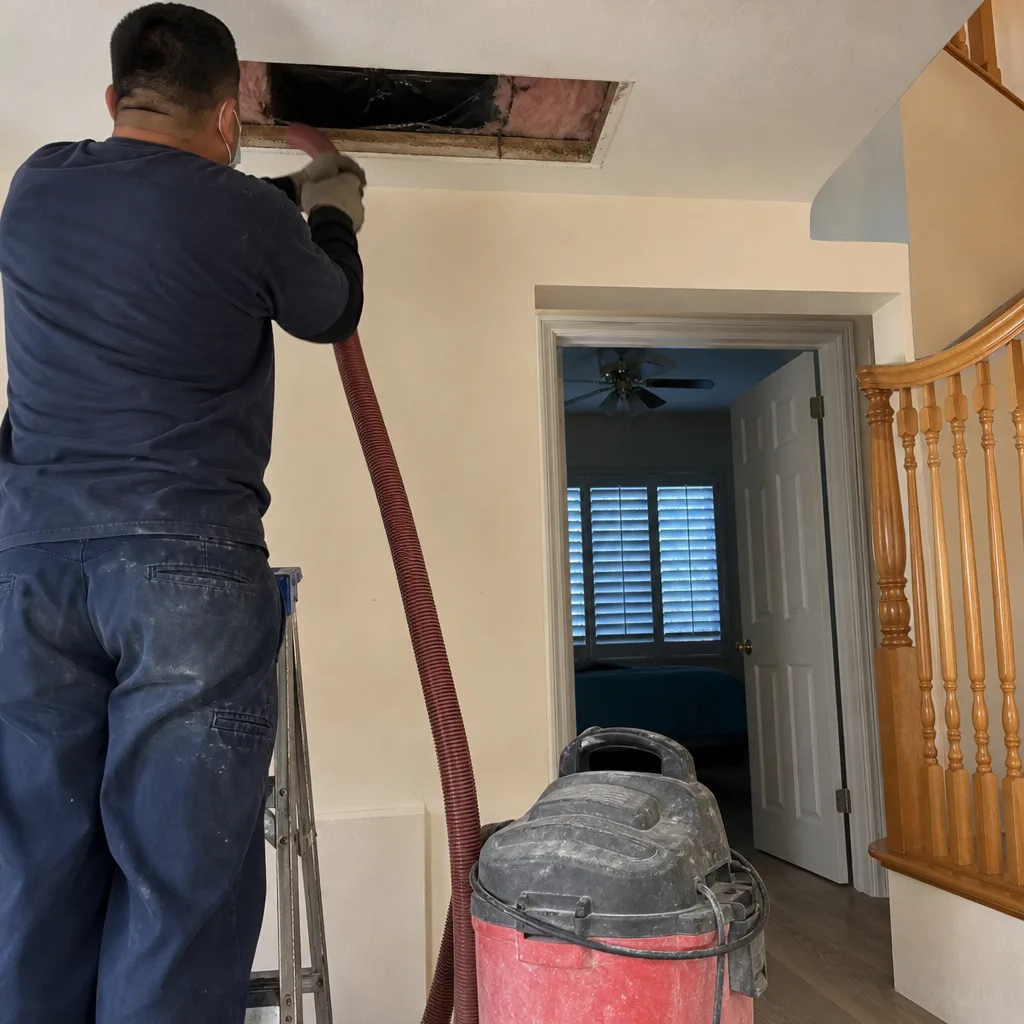
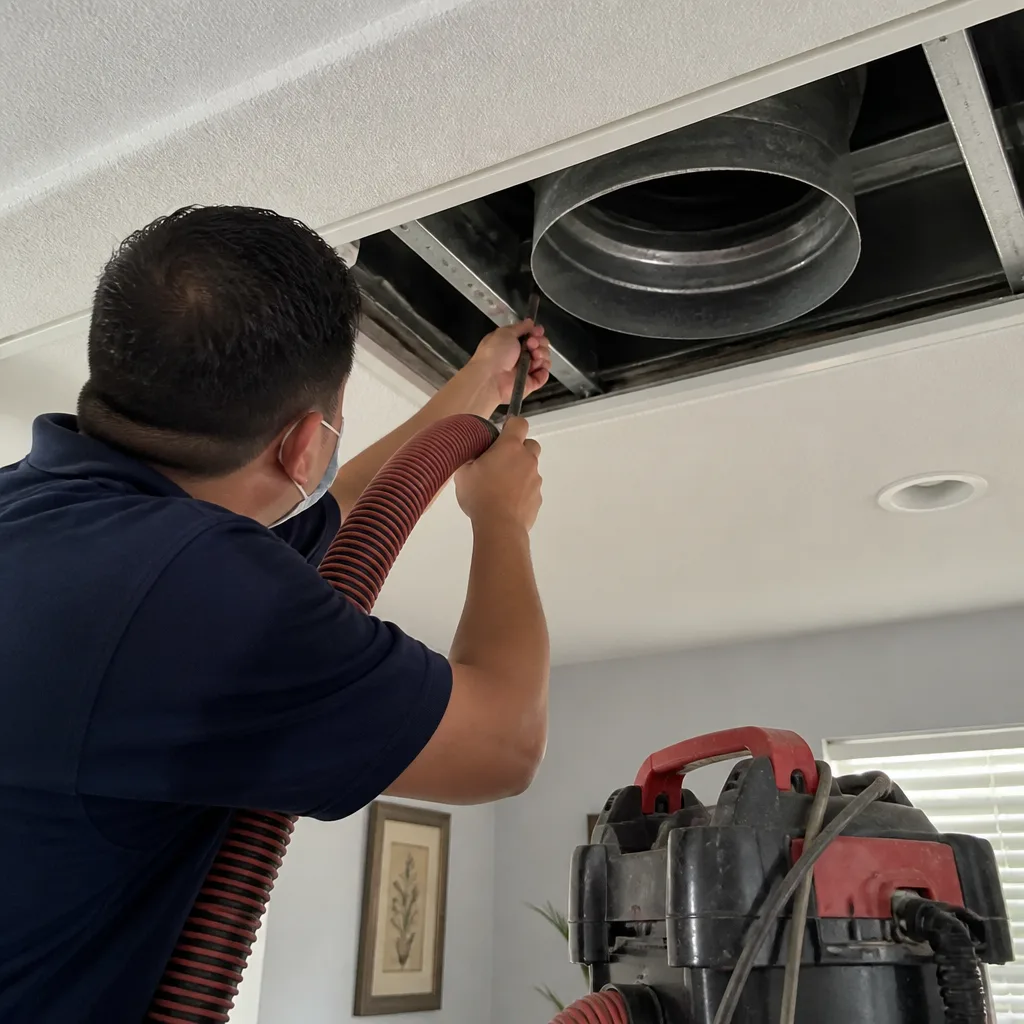
A professional setup works differently. A high-powered vacuum unit connects to the supply or return plenum and pulls the entire duct system under negative pressure, typically 2,000 CFM or more. That’s roughly ten to twenty times the airflow of a large shop vac. Once the system is under negative pressure, agitation tools including rotary brushes, air whips, and compressed air nozzles dislodge debris from duct walls. The debris is immediately pulled toward the vacuum, not allowed to settle. This is contact vacuuming. It’s called source-removal cleaning because the contaminant source is removed from the home, not relocated within it.
Consumer tools cannot achieve this for a simple reason: airflow. A shop vac moves 100 to 200 CFM at best, and that number drops dramatically through a 25-foot hose. A typical Milpitas home has 10 to 20 supply runs, each 10 to 30 feet long. A shop vac connected to one register at a time has no meaningful negative pressure at the far end of the duct. The brush dislodges debris, and the debris settles somewhere else in the system. In our experience, the most common place for that debris to settle is the return plenum and the air handler cabinet, right where it can damage the blower motor and contaminate the evaporator coil.
There’s no consumer product that solves this. Not the brush kits. Not the vacuum attachments. Not the endoscope cameras that let you see the debris, which confirms the problem exists but doesn’t remove it. The gap between consumer tools and professional equipment is not a matter of effort or technique. It’s a matter of airflow, and airflow is a function of the equipment, not the operator.
The Real Cost Comparison: DIY Savings vs. Risk-Adjusted Expense
Here’s the honest cost picture for a typical Milpitas single-family home with 10 to 14 supply runs.
| Approach | Upfront Cost | What It Includes | Risk-Adjusted Outcome |
|---|---|---|---|
| DIY brush kit + shop vac | $40 – $120 | Surface dislodging, no extraction | Debris relocated to air handler; potential coil contamination; no verification |
| DIY register vacuuming + filter change | $15 – $40 monthly | Surface maintenance only | Legitimate maintenance; no risk; extends time between professional cleanings |
| Professional source-removal cleaning | $450 – $900 for a typical Milpitas home | Negative-pressure extraction, contact agitation, full system cleaning, before/after documentation | Contaminant removed from home; verifiable result; documented for future reference |
| Professional remediation after failed DIY | $600 – $1,400+ | Source cleaning plus coil cleaning, blower cleaning, possibly duct repair | Cost exceeds original professional cleaning by 30 – 100% |
The savings from DIY brush cleaning appear to be $400 to $800. The risk-adjusted reality is different. The most common failure mode we see in Milpitas homes is a homeowner who ran a brush through supply ducts, then noticed reduced airflow within weeks. The cause: a mat of dislodged dust, pet hair, and debris had accumulated on the evaporator coil. Coil cleaning is not a DIY task. It requires coil cleaner, access to the air handler interior, and often partial disassembly. The cost to clean a contaminated coil and blower runs $250 to $500 on top of the duct cleaning that should have been done in the first place.
There’s also the flex duct puncture risk. Most homes in Milpitas built since the 1980s use flexible insulated duct for branch runs. A stiff brush or a tool with any sharp edge can puncture the inner liner. A puncture doesn’t just leak conditioned air into unconditioned spaces like attics and crawl spaces; it also draws insulation particles into the airstream. Duct repair for a punctured flex run costs $150 to $300 per run, and if the puncture is in an inaccessible crawl space, the labor cost rises.
The honest framework: DIY register maintenance saves money and should be done. DIY brush cleaning of duct interiors appears to save money and has a meaningful probability of creating a larger expense. Anyone considering the latter should price the professional cleaning at Air Duct Cleaning in Milpitas first, because the difference between that number and the risk-adjusted DIY cost may be smaller than expected.
When DIY Creates Professional Remediation Jobs
We don’t write this section to scare anyone. We write it because these are the specific scenarios we see when a DIY attempt goes sideways, and understanding them helps homeowners make better decisions before they start.
Scenario 1: Debris Deposited in the Air Handler
A homeowner runs a brush through supply ducts. The brush dislodges years of accumulated dust, hair, and dander. Without negative pressure, that debris migrates toward the return side and settles in the air handler cabinet. The blower wheel picks up some of it, becomes unbalanced, and starts vibrating. The evaporator coil gets coated, reducing heat transfer, and airflow drops. The system now runs longer to hit the same setpoint. The homeowner’s first clue is usually a higher July utility bill or a rattling sound from the closet where the air handler lives. At that point, the job is no longer duct cleaning. It’s duct cleaning plus coil cleaning plus blower cleaning. That’s a bigger invoice than if the professional cleaning had been booked first.
Scenario 2: Punctured Flex Duct
Flex duct’s inner liner is a thin plastic or foil layer, usually 4 to 6 mils thick. A drill-driven brush with any rigid component can tear it. The tear may be small enough to go unnoticed. Conditioned air leaks out. In a Milpitas attic, that means cool air in summer venting into a 140-degree space. The homeowner notices the room at the far end of that run isn’t cooling properly. An HVAC diagnosis finds the puncture. The fix is Air Duct Repair in Milpitas: cut out the damaged section, splice in new flex, seal the joints, re-insulate. It’s a straightforward repair, but it costs more than the DIY kit that caused it.
Scenario 3: Disturbed Lined Ductwork
Older Milpitas homes, particularly those built before 1975, sometimes have internally lined sheet metal ducts. The fiberglass lining was applied for noise control. It deteriorates over time. A brush or air tool can shred lining that was intact, releasing fiberglass particles into the airstream. Those particles then circulate through the home. The remediation is different from cleaning: the lining must be repaired or the affected sections replaced. This is rare, but it’s a failure mode that only exists when aggressive tools are used on ducts that were never designed for them.
The honest takeaway: the scenarios above don’t happen because homeowners are careless. They happen because the tools themselves are inappropriate for the surface being cleaned. It’s a tool-to-task mismatch, not a skill issue. And it’s avoidable by knowing where DIY stops being useful.
Milpitas-Specific Factors That Change the Equation
Milpitas has a particular set of conditions that shape how ducts get dirty and how often they need attention. These aren’t generic observations. They matter for any homeowner weighing DIY against professional service.
Valley dust load. Milpitas sits at the southern end of the San Francisco Bay, against the Diablo Range foothills. The prevailing winds carry fine particulate from the bay corridor and from the agricultural lands to the east. Homes in Milpitas accumulate a fine gray dust that’s different from the coarser debris common in coastal communities. This fine dust is exactly what bonds to duct walls and passes through standard filters, and it’s more difficult to dislodge than the larger particles most DIY tools are designed to remove.
Long cooling season. Milpitas runs air conditioning from May through October, and homes with south-facing exposure or poor attic insulation run it even longer in shoulder seasons. The longer the system runs, the more air passes through the ducts, and the more particulate deposits out on duct surfaces. This is a volume problem: total pounds of air moved per year correlates directly with duct contamination buildup.
Newer construction with flex duct. Much of Milpitas’s housing stock was built between 1985 and 2005, a period when flex duct became the standard for branch runs. Flex duct has a spiral inner liner that creates turbulence, which increases particulate deposition compared to smooth sheet metal. It’s also more vulnerable to damage from improper tools. This combination means Milpitas homes are more likely to have contaminated flex runs and more likely to experience tool-related damage if DIY methods go wrong.
Multi-story homes with long vent runs. Many Milpitas homes are two-story with vertical supply risers. A vertical duct run accumulates debris at the bottom of the riser, where gravity deposits it. Cleaning a vertical run is harder than cleaning a horizontal one, and it’s essentially impossible to do from a single register opening. Professional cleaning with negative pressure at the plenum can pull debris up and out of vertical runs. No consumer tool can manage this geometry.
The combined picture: Milpitas homes tend to have fine, bonded dust in flex ducts that run through hot attics and vertical risers. That’s a system that accumulates contamination efficiently and resists surface cleaning. It’s also exactly the profile where professional equipment earns its cost.
Maintenance Intervals: Using DIY Correctly as a Complement
DIY and professional cleaning aren’t competitors. They’re different parts of a maintenance schedule. The goal of good DIY habits is to reduce how often professional cleaning is needed and to keep the system healthy between visits. Here’s a working schedule for a typical Milpitas home.
Monthly:
- Inspect and replace the air filter if needed. In peak summer, every month is the right interval for most homes.
- Vacuum supply and return register faces. Remove visible dust and pet hair with a crevice tool.
- Check the dryer lint screen for damage and clean the trap housing with a narrow brush. A surprising amount of lint bypasses the screen and accumulates in the housing.
Quarterly:
- Remove a few registers and inspect the accessible duct interior with a flashlight. Look for visible dust accumulation, debris, or signs of moisture. This is an inspection, not a cleaning. Note what you see.
- Check the exterior dryer vent hood. Make sure the flap opens when the dryer runs and closes when it stops. Remove any visible lint from the exterior opening.
- Check the return grille. If the filter is located at the return, examine the grille face for dust caking, which may indicate filter bypass.
Every 3 to 5 years:
- Book a professional source-removal cleaning. Homes with pets, smokers, recent renovation dust, or allergy-prone residents should lean toward 3 years. Homes with excellent filter discipline and no pets can go to 5.
- Have the dryer vent professionally cleaned. This is a separate service from air duct cleaning and should not be skipped. Lint fires are real, and they kill people every year in the United States. Milpitas homes with long or multi-bend vent runs need this more often.
This schedule accomplishes something important: it makes professional visits less expensive. A duct system that has been filter-disciplined and register-maintained accumulates less bonded contamination. The professional cleaning takes less time, requires less aggressive agitation, and costs less than a neglected system with years of buildup. Good DIY habits don’t replace the professional visit. They reduce its frequency and its cost. That’s the correct relationship.
For the full scope of what a professional cleaning actually involves, start with Duct Cleaning Milpitas home.
Equipment Matters: What Professional-Grade Actually Means
The phrase “professional-grade” gets thrown around a lot. In duct cleaning, it means something specific. Professional equipment is designed for one task: generating enough airflow to create negative pressure across the entire duct system while an agitation tool works the interior surfaces.
Rotobrush and Nikro are two recognized names in this space. These are not shop vacs with longer hoses. They are truck-mounted or portable units built around high-CFM vacuum systems, typically 2,000 CFM or more. The vacuum unit connects at the plenum or trunk line, and the entire duct system becomes a sealed vacuum path. Agitation then happens under that vacuum. Debris dislodged by the brush or air whip is carried toward the vacuum intake, not released into the home or pushed toward the air handler.
This matters for a reason that’s easy to understand: cleaning is a process, not an event. The process has three steps in a NADCA-compliant source-removal cleaning. First, the system is placed under negative pressure. Second, each duct run is agitated to dislodge bonded debris. Third, the system is evaluated to confirm debris removal. Step two without step one is just stirring dust. Step one without step two leaves bonded contamination in place. All three steps require equipment designed for this specific job.
There’s also a broader air-quality dimension. The same homes that need duct cleaning often need better filtration. Honeywell and Aprilaire make media filters and electronic air cleaners that do a fundamentally different job than the standard 1-inch fiberglass filter. A professional who works with these products can recommend a filtration upgrade that’s matched to the system’s static pressure budget, not just a higher MERV rating that chokes airflow. Abatement Technologies occupies another corner of the professional space: source-capture and contamination-control equipment built for indoor air quality work. A specialist who uses Abatement Technologies equipment isn’t just vacuuming ducts. They’re doing contamination control, which is the appropriate frame for a serious IAQ problem.
The Milpitas homeowner’s takeaway: equipment brands are a useful signal. If a contractor can’t name the equipment they use, or if the equipment they describe sounds like something from a hardware store, that’s an answer. Professional duct cleaning requires professional airflow generation. That’s not marketing language. It’s a physical requirement of the task.
Common Mistakes to Avoid
- Using a dryer vent brush on HVAC supply ducts. The tool is designed for short, straight, smooth-metal vent runs, not long, flexible, interior-lined HVAC ducts. It dislodges debris without extraction and can damage flex duct liners. This is the single most common DIY mistake we see in Milpitas homes.
- Assuming visible register dust means dirty ducts. Register dust is often normal accumulation at the vent face. The question is what’s inside the duct runs, and that requires visual inspection with proper equipment, not extrapolation from a dusty grille.
- Skipping filter replacement because the ducts were “just cleaned.” Filter replacement is a continuous responsibility. A duct cleaning does not replace filter discipline. In Milpitas cooling season, a clogged filter re-contaminates a clean system quickly.
- Believing that higher MERV is always better. A MERV 13 filter on a system not designed for that static pressure reduces airflow, increases energy use, and can cause coil freeze-up in summer. Filter upgrades should be matched to system capability.
- Ignoring the dryer vent while focusing on the HVAC ducts. The dryer vent is a fire hazard. It carries lint at high temperature, and lint is highly combustible. Many Milpitas homeowners schedule a full duct cleaning and never ask about the dryer vent, which may present a greater immediate risk than the HVAC system.
- Hiring a low-price duct cleaner without asking about equipment. The industry has a well-known problem with bait-and-switch pricing: a low per-vent price that becomes a much larger invoice after the technician arrives. Homeowners should ask what equipment will be used and what the total price for the system is. One flat price per system, agreed before work starts, is the honest model.
See the difference
 Before
 After
 Before
 After
 Before
 After
When to Call a Professional
Call a professional if you can see visible debris in the ducts beyond the first few inches, if someone in the home has unexplained allergy symptoms that improve when the HVAC is off, if there’s evidence of rodents or pests in the ducts, if the system hasn’t been cleaned in more than five years, if you’ve done renovation work that generated dust, or if any previous DIY attempt may have dislodged debris into the air handler. These are not maintenance situations. They require the equipment and process that only our Air Duct Cleaning services bring. Duct Cleaning Milpitas offers free estimates in Milpitas. Call (877) 358-5491 to get a flat price for your system. No per-vent pricing. One price per system, agreed before work starts.
Frequently Asked Questions
A professional source-removal cleaning for a typical Milpitas single-family home with 10 to 14 supply runs ranges from $450 to $900. Larger homes, systems with accessible rooftop units, or ducts with heavy contamination run higher. The price should be quoted as one flat rate per system, not per vent. Be wary of any per-vent quote, because that pricing model is how low teaser prices become inflated invoices. Call (877) 358-5491 for an exact quote for your home. Estimates are free.
Because they’re not doing the same job. A cheap quote often reflects a shop vac connected to the register, not a negative-pressure source-removal system. The technician may spend 45 minutes instead of several hours, may not access the trunk lines, and may not provide before-and-after documentation. Some low quotes are deliberate bait: the price climbs once the technician arrives and “discovers” additional work. One flat price per system, agreed before work starts, eliminates that dynamic.
Ask for before-and-after photos of the interior duct surfaces, not just the register openings. A legitimate professional cleaning includes visual documentation of the trunk lines and branch runs. The photos should show the actual surfaces that were cleaned. If a company can’t or won’t provide interior documentation, that’s a signal. You should also be able to inspect the ducts yourself after the job with a flashlight for the first few accessible feet.
Every 3 to 5 years for most Milpitas homes. Homes with pets, smokers, or residents with diagnosed allergies should lean toward every 3 years. Homes with disciplined filter replacement, no pets, and newer construction can extend to 5 years. The interval is not a fixed number; it’s a function of system runtime, filter discipline, occupant count, and the home’s dust load. If you’re in a newer Milpitas neighborhood like the area near McCarthy Ranch or the Great Mall, construction dust from nearby development work may shorten the interval temporarily.
You can clean the first few inches of duct at the register face. You cannot clean the interior of the duct runs. A shop vac lacks the airflow to create negative pressure across the system, so any debris you dislodge settles elsewhere in the ducts or migrates toward the air handler. This is the single most common way homeowners create a needed remediation job. If you want to maintain the system, vacuum the register faces and replace the filter. Leave the duct interior to equipment designed for it.
Air duct cleaning, done properly, removes accumulated dust, pet dander, and particulate from the duct system. It is not a scam when the work is real and documented. The legitimate criticism of the industry is pricing practice: low teaser quotes that become inflated invoices. The service itself has value, particularly in a high-runtime cooling climate like Milpitas, where the HVAC system moves a large volume of air over a long season and deposits particulate in the ductwork. The answer is not to skip cleaning. The answer is to hire a service that quotes one flat price per system and documents the work.
The Bottom Line
DIY air duct maintenance is real, and it has a clear scope: register vacuuming, filter replacement, and dryer lint trap care. Those tasks keep a system healthy between professional cleanings and should be done consistently. What DIY cannot do is clean the duct interior, because no consumer tool generates the negative pressure required for source removal. The homeowner who understands this boundary saves money and avoids creating expensive problems. The homeowner who ignores it usually learns the lesson through a contaminated coil, a punctured flex run, or a system that performs worse after the “cleaning” than before. In Milpitas, with its long cooling season and fine valley dust, the professional cleaning is not a luxury. It’s the scheduled maintenance that makes the DIY tasks meaningful. For more guides & resources, see our blog.
If you’re ready to get a flat price for your system, call (877) 358-5491. We’ll walk the system with you, explain what we see, and give you one number before any work starts. No per-vent pricing. No surprises.
Written by the team at Duct Cleaning Milpitas, serving Milpitas since 2018.